
Fire history
There is no single global history of fire: every region has developed its own relationship with fire, shaped by its role in ecosystems, culture, economic activities, and climate. Pyrosfera introduces fire history with a timeline of the Iberian Mediterranean region, a fire-adapted landscape where fire has long been both a natural process and a human tool.
Iberian Mediterranean region timelineBy exploring this specific history, Pyrosfera illustrates broader dynamics relevant to many fire-prone regions worldwide and is designed to be expanded with additional regional histories over time. It also proposes Integrated Fire Management (IFM) as an approach to address and reduce the negative impacts of fire, while emphasising that pathways toward IFM must always be grounded in local ecological and social contexts.
Want to know more?~3.5 Million years ago – Present
Fire as a natural disturbance

Fire has been present on Earth since plants colonised land, around 420 million years ago, establishing itself as a key ecological disturbance. In the Mediterranean Basin, evidence suggests that fire has shaped ecosystems for around 3,5 million years.
Fire activity has been influenced by multiple factors, including climate (higher fire activity during warmer periods), atmospheric oxygen levels, and vegetation types.
Fire has shaped Mediterranean ecosystems at different times and rates, with plants retaining survival traits such as thick bark, shedding of lower branches, resprouting, and fire-stimulated germination.
Fire across the Mediterranean region contributes to biodiversity, a patchy mosaic in the landscape, and nutrient cycling.
~1.5 million – ~200,000 years ago
Fire and early humans
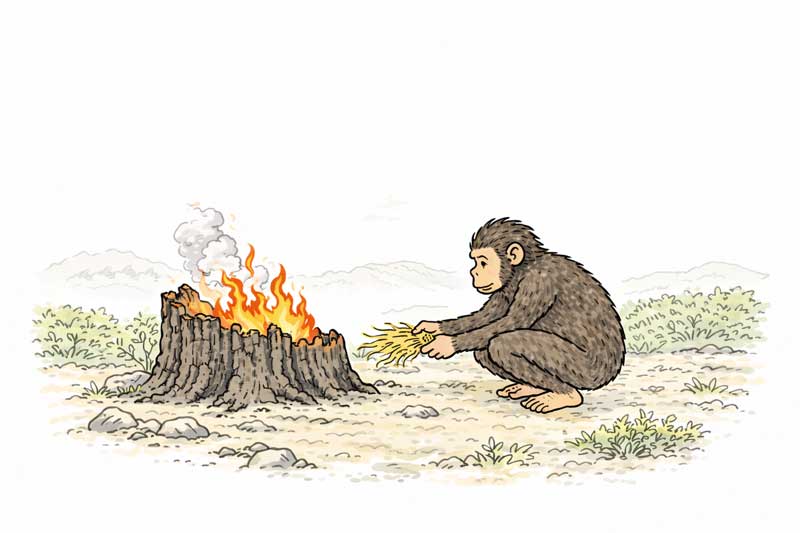
Human ancestors learned to use fire for warmth, protection, and cooking.
They used fire in small, opportunistic ways that could slightly affect local vegetation.
~200,000 years ago – ~12,000 years ago
Fire and modern humans

Modern humans (Homo sapiens) used fire to manage resources and influence landscapes, e.g., by burning shrublands to promote the growth of edible plants and maintain open areas for hunting and foraging.
Fire knowledge was passed down through generations and embedded in local traditions.
~12,000 years ago – ~5,000 years ago
Fire in early farming and pastoralism

Early farmers and shepherds used fire to clear land, renew pastures, and favour crops.
This favoured mosaic landscapes that supported biodiversity and limited large fires.
10th – 20th c.
Fire in agrarian and pastoral landscapes

Rural communities, living directly from the land, used fire to maintain open landscapes and reduce vegetation biomass for survival needs, e.g., clearing land for grazing or accessing wood. These practices also created mosaic landscapes that limited fire spread.
Traditional forest management (e.g. silviculture or wood picking for heat and cooking) reduced fuel loads in woodlands.
Fire use was regulated by customs and local knowledge rather than central authorities.
Land-use changes, including deforestation and agricultural intensification, increased fire risk by creating more flammable vegetation, accumulating dry shrubs and grasses, and enhancing fuel continuity across landscapes.
16th – late 19th c.
Fire suppression and institutional change

Fire increasingly came to be seen as a threat to forests, property, and economic resources, as more people concentrated in urban areas.
Expanding state institutions and private land ownership led to stricter fire regulations and suppression policies.
Centralised control gradually replaced local long-standing fire-use practices.
18th – 19th c.
Fire and the Industrial Revolution

Industrial expansion and mechanised agriculture transformed rural landscapes across the Iberian Mediterranean, as the rise of fossil fuels gradually replaced wood and charcoal as energy sources.
Plantation forestry and more uniform forest management replaced mixed-use landscapes, altering fuel continuity and fire behaviour.
Mid-20th c. – 1980s
Rural exodus and fuel accumulation

Large-scale rural abandonment reduced grazing, farming, and traditional fire use.
Vegetation accumulated, increasing the continuity and amount of fuel in the landscape.
Fire regimes began to change, with fewer fires but higher potential intensity.
1980s – Present
Fire science and modern management
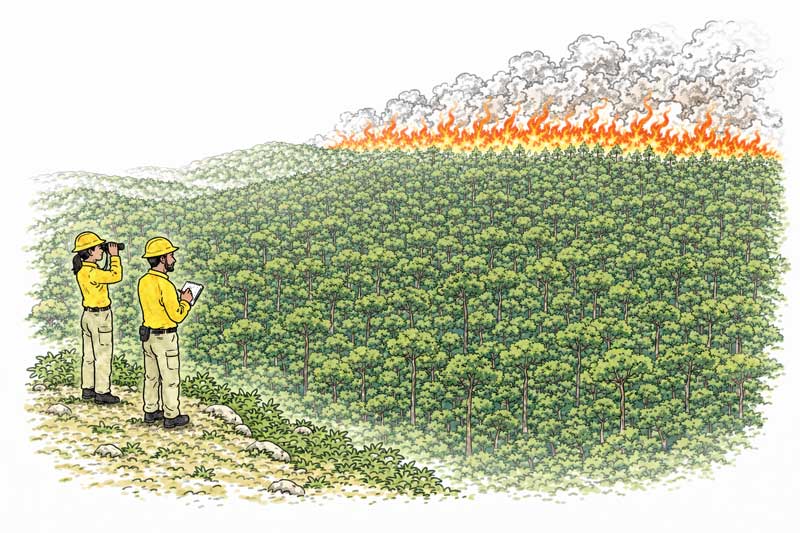
The fields of fire ecology, behaviour modelling, and fire analysis matured and began to be widely applied in the Iberian Mediterranean, informing more scientific approaches to fire management.
Fire management expanding from suppression to include risk analysis and mitigation.
Scientific, operational and traditional knowledge increasingly challenging exclusion-only approaches, which can backfire by letting fuels accumulate and causing more severe fires.
1990s – Present
Climate crisis and extreme wildfires

Rising temperatures, droughts, and heatwaves intensify fire behaviour. Together with the expansion of housing into natural areas and reduced landscape management, it is making fires more intense and damaging.
Extreme wildfires exceed suppression capacity and cause severe social and ecological impacts.
Fire is now a priority risk in the Mediterranean.
21st c. – Present
Towards Integrated Fire Management (IFM)

IFM emerges as an alternative to classical fire prevention and suppression approaches. It recognises fire not only as a risk, but also as an ecological process and a necessary practice for local livelihoods, integrating both environmental and cultural dimensions to improve fire management outcomes.
Combines mitigation, suppression and restoration phases, with a holistic and long-term vision.
Promotes the integration of traditional and ancestral fire knowledge from local communities with scientific and operational expertise, as a foundation for strengthening it.
Calls for stronger political commitment and cross-sector governance.