
Integrated Fire Management
IFM is a holistic approach that integrates the ecological, social, economic and governance dimensions of fires across landscapes. It addresses all aspects of wildfire management, from prevention and preparedness to active response.
IFM also considers the ecological relationships of wildlife and vegetation with fire (tolerance, resilience) as well as the socio-cultural aspects of safeguarding life and well-being, considering traditional and Indigenous cultures. By combining scientific, technical, and traditional knowledge, IFM strengthens the capacity of people and ecosystems to adapt to changing fire patterns while reducing the impacts of destructive wildfires.
To Learn More
Integrated fire management as an adaptation and mitigation strategy to altered fire regimes – Imma Oliveras et al. (2025)
Integrated Fire Management voluntary guidelines. Principles and strategic actions – FAO (2024)
Integrated Fire Management or how to reduce the risk of large wildfires wisely – Lucía de la Riva (2023)
Diving into the concept of Integrated Fire Management: let’s dialogue and connect with local communities – Lucía de la Riva (2023)
Living with Fire— Sustaining Ecosystems & Livelihoods Through Integrated Fire Management – Ronald L. Myers (2006)
Five core IFM Goals
Resilient
landscapes
IFM strengthens the capacity of landscapes to recover from fire while maintaining ecological functions.
In the Sierra de Gata-Las Hurdes region of central Spain, local land managers use a mosaic approach—small-scale interventions such as managed grazing, crop rotation, and controlled shrub clearing—to create a patchwork of vegetation types and fuel loads. This heterogeneity limits fire spread, confines potential wildfires to smaller areas, and supports biodiversity.
Landscape resilience. Basics, case studies, practical recommendations – Catrin Schmidt (2022)
Fire-Smart Territories: a proof of concept based on Mosaico approach – Fernando Pulido et al. (2023)

Sustainable local livelihoods
IFM promotes local livelihoods and integrates traditional knowledge into fire management.
In parts of Central and South America, indigenous communities apply traditional burns and manage agricultural plots using ancestral techniques to maintain soil fertility, reduce wildfire risks, and sustain food production and income. These practices show how cultural knowledge and ecological stewardship combine to support community well-being, reaffirming the strategic role of communities in fire management and use, and strengthening community governance.
Exploring the role of traditional ecological knowledge in climate change initiatives – Kirsten Vinyeta, Kathy Lynn (2013)
Traditional forest-related knowledge and climate change – John A. Parrotta, Mauro Agnoletti (2011)
Revitalising Indigenous cultural fire practice: benefits and partnerships – Kirsten MacLean et al. (2022)
Community-based fire management in Bolivia: integrating people, knowledge and good practices – Verónica Ibarnegaray et al. (2022)

Balanced ecosystems
IFM conserves and restores ecological integrity by maintaining fire-adapted habitats and species diversity.
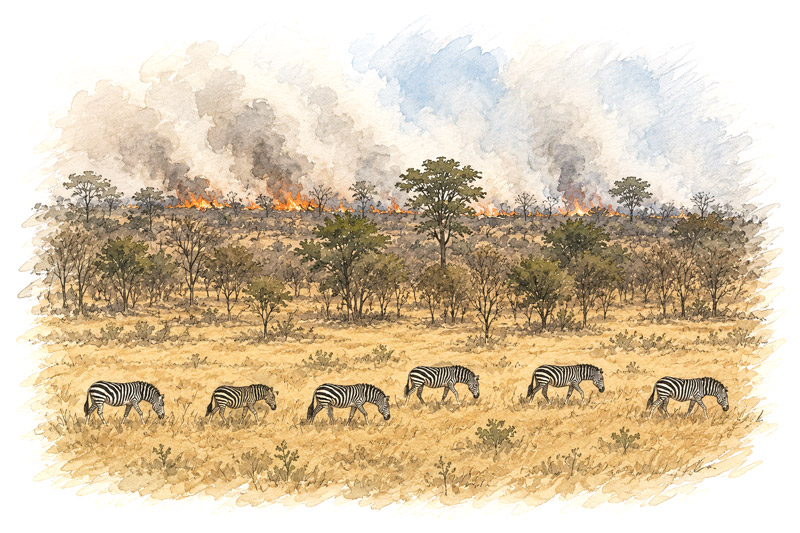
In African savannas, regular low-intensity fires control tree and shrub density, prevent grasslands from becoming dense thickets, and preserve habitat mosaics that support herbivores and birds. By allowing fire to fulfil its natural ecological role, managers sustain ecosystem structure and biodiversity.
The use of fire to preserve biodiversity under novel fire regimes – Roger Puig-Gironés et al. (2025)
Effects of fire on woody vegetation structure in African savanna – Izak P. J. Smit et al. (2010)
Wildfire
risk reduction
IFM mitigates the risk and impact of destructive wildfires through strategic fuel treatments, with prescribed burns as a central tool.
In fire-adapted ecosystems, like those in Portugal e.g., managers apply prescribed burns to portions of the landscape, reducing fuel load and continuity and limiting the size and severity of wildfires. This targeted approach increases the likelihood of effective wildfire control and protects communities and ecosystems.
Empirical Support for the Use of Prescribed Burning as a Fuel Treatment – Paulo M. Fernandes (2015)

Reduction of carbon emissions
IFM lowers greenhouse gas emissions by managing fire timing, extent, and intensity.
In the northern Australian savannas, Indigenous communities conduct early dry-season burns to create a vegetation mosaic that prevents the spread of high-intensity fires later in the season. This planned and sustainable burning approach reduces emissions from uncontrolled fires while maintaining ecosystem functions and supporting local livelihoods.
Can savanna burning projects deliver measurable greenhouse emissions reductions and sustainable livelihood opportunities in fire-prone settings? – Jeremy Russell-Smith et al. (2017)
Viability and desirability of financing conservation in Africa through fire management – Tony Knowles et al. (2025)
